The Hidden Math of Home Health: Why Recovery Truly Begins at Home
For many patients and families in Idaho Falls, the day of hospital discharge feels like the finish line. The surgery is done, the treatment is complete, and the goal has been achieved. But medical data reveals a different truth: the hospital exit is often just the starting line. The transition from a monitored hospital ward to the comfort of your own bedroom is one of the most critical phases in a patient’s journey, and it is where the true value of post-hospital home health recovery is revealed.
We explored the “hidden math” of recovery—the data-driven insights that prove why skilled nursing and therapy in the home are the most powerful tools for preventing hospital readmissions. This is especially true for those utilizing Home Health Idaho Falls services, making Home Health Idaho Falls a vital component in recovery.
Table of Contents
- The Silent Gap After Hospital Discharge
- Why Home Health in Idaho Falls Is the Most Critical Clinical Setting
- The Invisible Epidemic Skilled Nursing Detects at Home
- How Layered Home Health Care Reduces Hospital Readmissions
- Addressing Bias and Blind Spots in Home Monitoring Technology
- Protecting Fragile Skin Through Patient-Centered Home Care
- Bridging Hospital Discharge Planning to Real Life in Idaho Falls
- Redefining Recovery: Why Healing Doesn’t End at Discharge
1. The Silent Gap: Why Home Health in Idaho Falls Matters Most After Discharge
The car door closes. The hospital fades behind you. For the first time in days, there are no alarms, no nurses down the hall, no immediate safety net.
This moment reveals what clinicians call the “silent gap”, the space between hospital discharge and stable recovery at home.
Medication changes, missed symptoms, mobility challenges, and unmanaged side effects often emerge here. Modern healthcare data increasingly shows that outcomes are shaped less by what happens inside the hospital and more by what happens after.
That’s why home health care in Idaho Falls is now recognized as one of the most predictive factors in recovery success.
2. The Invisible Epidemic: How Skilled Home Health Nurses Catch What Others Miss
Some conditions don’t announce themselves clearly.
Hypertrophic Cardiomyopathy (HCM), for example, is one of the most common inherited heart diseases, yet it remains significantly underdiagnosed.
The data reveals:
-
The Prevalence: Clinical research from the CDC indicates between 1 in 200 and 1 in 500 people carry the condition.
-
The Diagnostic Chasm: Only about 100,000 people in the U.S. are currently diagnosed.
-
The “Missing” 85%: Roughly 85% of those at risk are moving through life—and recovery—without a clinical label.
The Home Health Advantage: HCM does not discriminate by age or ethnicity. A skilled home health nurse doesn’t just check vitals; they are trained to spot the subtle signs of cardiac distress that a family member might miss. By identifying these “missing” symptoms early, home health providers turn a blind spot into a managed care plan.
Through consistent in-home assessments, home health services in Idaho Falls help turn clinical blind spots into proactive care plans, often preventing emergency visits before they happen.
3. The “More Is Better” Rule: How Home Health Care Reduces Hospital Readmissions
Reducing 30-day hospital readmissions isn’t about one heroic intervention. It’s about layering small, consistent actions.
The Math: There is a linear correlation between the number of transitional care processes and the Risk Standardized Readmission Rate (RSRR). Studies on improving readmission rates show that for every additional process implemented, outcomes improve significantly. A landmark VA hospital study found:
- A linear relationship between the number of care transition processes and lower readmission rates
- For every one-point increase in process adherence, readmissions dropped by 0.185%
- No hospital successfully implemented all recommended processes alone
This is where home health in Idaho Falls becomes a force multiplier.
Agencies like Eden Health coordinate:
- Medication reconciliation
- Skilled nursing visits
- Therapy and mobility training
- Follow-up communication
- Patient and caregiver education
The math favors consistency, and consistency happens best at home.

4. Addressing Hidden Bias in Pulse Oximetry and Home Monitoring
Technology is powerful, but not perfect.
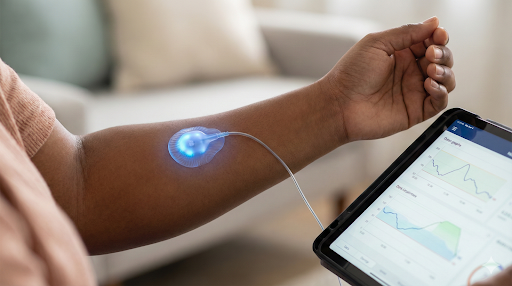
Research highlighted by institutions like Johns Hopkins indicates that when darker pigmentation is combined with low perfusion (low blood flow), standard sensors can miss signs of hypoxemia (low oxygen).
Studies have shown that pulse oximeters may be less accurate in patients with darker skin pigmentation, especially when circulation is compromised. This can lead to missed signs of hypoxemia.
The solution isn’t abandoning technology, it’s augmenting it.
A trained home health clinician evaluates:
- Skin temperature and color
- Respiratory effort
- Mental alertness
- Overall clinical presentation
By combining data with professional observation, home health care protects patients where devices alone fall short.
5. The Physicality of Care: Protecting Fragile Skin at Home
Innovation doesn’t always mean complexity.
For older adults and medically fragile patients, even standard adhesives can cause skin tears and infections. In home health settings, preserving skin integrity is critical.
Newer technologies, such as silicone-based sensors and gentler materials, reduce trauma and improve patient compliance. When care is comfortable, patients are more likely to wear monitoring devices consistently, leading to better data and better outcomes.
This is one of the understated benefits of skilled home health services in Idaho Falls: care that adapts to the patient, not the other way around.
6. Bridging Hospital Discharge Planning to Real Life in Idaho Falls
Hospitals excel at discharge paperwork. What’s often missing is someone to walk the plan into the home.
Research shows that while social workers are essential during hospitalization, continuity often breaks once the patient leaves.
Home health bridges that gap by:
- Partnering with patients instead of issuing instructions
- Connecting families to community resources like Meals-on-Wheels
- Using the teach-back method to confirm understanding
- Coordinating nursing, therapy, and support services
Eden Health manifests this bridge in Idaho Falls and beyond. We provide the physical therapy, skilled nursing, and hospice care that takes place where the patient actually lives. Closing the gap requires:
-
Partnering vs. Telling: Including the patient in the planning.
-
Community Integration: Plugging patients into local networks like Meals-on-Wheels.
-
The “Teach-Back” Method: Ensuring a patient can explain their care plan back to the clinician, moving beyond a simple signature on a form.
7. Redefining Recovery: Why Healing Doesn’t End at Discharge
Hospital discharge isn’t an exit, it’s a transition.
The data is clear: recovery outcomes improve when care continues in the environment where patients actually live. When skilled nursing, therapy, and education follow patients home, complications decrease and confidence grows.
If the difference between healing and readmission is a series of small, consistent steps, the math is undeniable.
With the right home health team in Idaho Falls, recovery doesn’t end when you leave the hospital.
It finally begins.
Frequently Asked Questions About Home Health in Idaho Falls
What does home health care include?
Home health care includes skilled nursing, physical therapy, occupational therapy, medication management, and monitoring, all provided in the patient’s home with a physician’s order.
How does home health reduce hospital readmissions?
By monitoring symptoms early, managing medications correctly, and addressing mobility or safety risks before they escalate.
Who qualifies for home health services after discharge?
Patients who are homebound and require skilled medical care ordered by a physician typically qualify. Medicare and most insurers provide coverage.
Ready to Take the Next Step?
If you or a loved one is transitioning home after hospitalization, Eden Health’s home health services in Idaho Falls are here to support safer, stronger recovery — right where healing works best.
Contact Eden Health today to learn how we can support your recovery journey.