
October is Breast Cancer Awareness Month. For many people, that brings reminders about screening, early detection, pink ribbons, and stories of survivorship. But for someone who has just heard the words “you have breast cancer,” awareness suddenly becomes deeply personal.
After a breast cancer diagnosis, even a short appointment can leave you carrying more information than you know what to do with. There may be unfamiliar terms, test results, specialists, phone calls, family conversations, and decisions ahead. You may be wondering what happens next — while still trying to absorb what has already happened.
If that is where you are right now, you do not have to understand everything today. You do not have to memorize every medical term. And you do not have to organize every part of the weeks ahead all at once.
Your oncology team is the right source for decisions about your diagnosis, testing, and treatment. What we can do here is help you approach the next steps with a little more structure: what to write down, what to ask, who to involve, and how to think about the support you may need at home.
These 10 steps are not a treatment plan. Think of them as a practical starting point for the conversations and everyday decisions that often follow a new diagnosis.
Table of Contents
- Give Yourself Time to Process the Diagnosis
- Understand What You Know — and What You Don’t Know Yet
- Prepare Questions for Your Next Appointment
- Create One Place for Your Medical Information
- Ask About Your Treatment Plan and Timeline
- Consider Whether You Want a Second Opinion
- Choose Your Support Team
- Prepare for Everyday Life During Treatment
- Take Emotional and Practical Concerns Seriously
- Know Who to Call and When
- How Support at Home May Fit Into Recovery
- Questions Families Often Ask
- Your First-Week Breast Cancer Checklist
1 Give Yourself Time to Process the Diagnosis
One of the first things to understand after a breast cancer diagnosis is that there is no single “right” way to react.
You may feel frightened. Angry. Focused. Numb. Ready to research everything. Completely uninterested in reading one more thing about cancer. Sometimes those reactions change from one hour to the next.
A diagnosis can introduce a tremendous amount of information very quickly. Even a relatively short appointment may include unfamiliar terminology, test results, names of specialists, possible next steps, and questions about future treatment.
You are not expected to remember everything the first time you hear it.
The National Cancer Institute encourages people facing a cancer diagnosis to prepare questions and ask for clarification about their diagnosis and what comes next. If something does not make sense, asking your clinician to explain it again in everyday language is a reasonable part of the conversation.
Your first job is not to become an expert on breast cancer overnight. It is to begin understanding your diagnosis, one conversation at a time.
2 Understand What You Know and What You Do Not Know Yet
“Breast cancer” is the beginning of an explanation, not the end of one.
Your care team may discuss information from a biopsy or pathology report, whether additional tests are needed, characteristics of the cancer, and which specialists should be involved. Some answers may already be available. Others may still be pending.
Two questions can be especially helpful: “What do we know for certain today?” and “What are we still waiting to learn?”
Those questions help separate confirmed information from possibilities. The National Cancer Institute suggests asking what type of cancer you have, whether more tests are needed before treatment, and which types of doctors should be involved in your care.
If someone uses a term you do not understand, write it down and ask. You do not have to interpret a pathology report by yourself.
3 Prepare Questions for Your Next Appointment
It is surprisingly easy to walk into an appointment with ten questions in your head and remember only two once the conversation begins.
Write them down beforehand. Put the questions that matter most to you at the top. Susan G. Komen offers breast-cancer-specific discussion guides that patients can print or save on a phone or tablet and use to record answers during appointments.
You might start with the questions below.
Questions About Your Diagnosis
- What type of breast cancer do I have?
- What have the tests told us so far?
- Are we still waiting for any results?
- Do I need additional tests?
Questions About Treatment
- What treatment options are being considered?
- What is the goal of each treatment?
- When do I need to begin treatment?
- What side effects or symptoms should I report?
Questions About Your Care Team
- Which specialists will be involved?
- Who is my main contact when I have questions?
- Who should I call after normal office hours?
Questions About Daily Life
- Are there activities I should avoid?
- Can I continue working?
- Should I plan to have someone help me after treatment or surgery?
- What changes might I need to make at home?
You do not need to ask every question in one visit. Start with what matters most to you and add questions as they come up.
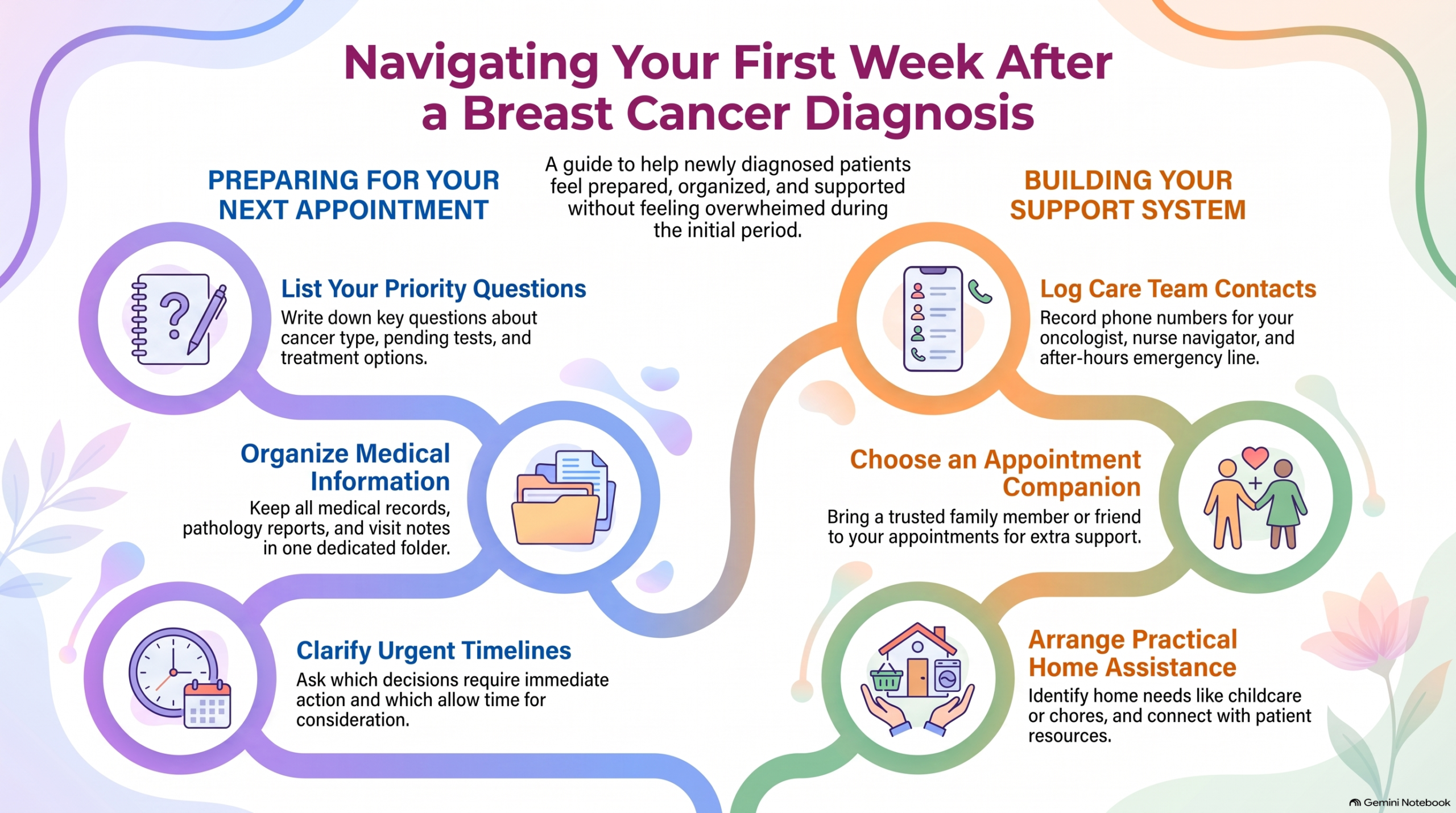
4 Create One Place for Your Medical Information
You do not need a complicated filing system. You need something you will actually use.
A notebook, folder, binder, notes app, shared document, or patient portal can all work. Keep the names and contact information for your clinicians, appointment dates, medication list, test results, questions, and instructions together.
Ask which results are still pending and when someone will discuss them with you. If a portal message is unclear, contact the office instead of trying to guess what it means.
The goal is not a perfect medical archive. It is having one reliable place to look when you need an answer.
5 Ask About Your Treatment Plan and Timeline
One question can make the weeks ahead easier to understand: “What happens next?”
Ask your care team to walk you through the expected sequence. Your path may include additional testing, specialist visits, treatment decisions, surgery or other treatment, and follow-up — but the order and timing are individual.
The National Cancer Institute recommends asking about available treatments, their benefits and risks, when treatment needs to begin, and how the care team will know whether treatment is working.
Another useful question is: “Which decisions do I need to make now, and which decisions can wait?” Not everything needs to be solved in the same afternoon.
6 Consider Whether You Want a Second Opinion
Some people feel comfortable moving forward with their first treatment team. Others want another specialist to review the diagnosis or proposed plan.
A second opinion does not have to mean that you distrust your doctor. It can confirm the proposed approach, provide another perspective, answer additional questions, or identify other options to discuss.
The National Cancer Institute explains that a second-opinion physician may review pathology reports, slides, scans, and other records. The second clinician may agree with the original plan, suggest changes, or provide additional information.
If you are considering a second opinion, ask how quickly treatment decisions need to be made, what records will be needed, whether your insurance has requirements, and whether the current office can help transfer your records.
7 Choose Your Support Team
Support does not have to mean telling everyone you know.
You decide who is involved and how. One person may come to appointments. Another may help with meals. Someone else may handle transportation, school pickup, or grocery shopping. And one friend may simply be the person you call when you do not want to talk about cancer at all.
People often say, “Let me know if you need anything.” When you can, turn that generous offer into something specific: “Could you drive me Tuesday?” “Would you bring dinner Thursday?” “Could you take notes during my appointment?”
Specific requests can make it easier for people who genuinely want to help — and easier for you to accept that help without having to organize everything yourself.

8 Prepare for Everyday Life During Treatment
Cancer treatment does not happen separately from the rest of life. There are still meals, laundry, children, pets, work, prescriptions, transportation, and a house that somehow continues needing attention.
Before treatment begins, ask your oncology team what changes you might reasonably expect and what preparation makes sense for your particular plan.
You may want to think about transportation to appointments, meal preparation, grocery shopping, childcare, time away from work, medication organization, help after surgery, and who could step in if your energy or mobility changes temporarily.
Do not assume you will need all of these things. And do not assume you will need none of them. A little planning before help is needed can make a difficult week more manageable.
After breast surgery, your needs may be different than they were before surgery. Depending on the procedure and your overall health, your care team may give you instructions related to incision or drain care, medications, activity, mobility, and follow-up appointments. If you have difficulty managing these needs at home, ask your treating provider whether skilled home health or another type of support may be appropriate.
9 Take Emotional and Practical Concerns Seriously
Medical questions are not the only legitimate questions after a breast cancer diagnosis.
You may also be thinking: How do I tell my children? What happens with work? How will we manage transportation? What about the cost? What if I cannot sleep? What if I am scared all the time?
Those concerns are not distractions from cancer care. They are part of living through it.
Tell your care team when emotional or practical concerns are making daily life harder. Ask whether your cancer center has a patient navigator, oncology social worker, counselor, support group, financial counselor, transportation resources, or other community support.
You do not have to wait until a problem becomes a crisis before asking what resources are available.
10 Know Who to Call and When
Before leaving an oncology appointment, make sure you know who to call with questions, who to contact after hours, which symptoms your team wants reported, and what your team considers urgent or an emergency for your particular situation.
The answers depend on your diagnosis and treatment. That is why your oncology team’s instructions should always take priority over a general article or internet search.
Write the contact information somewhere easy to find. If someone is helping care for you at home, make sure they know where it is too — with your permission.
You do not want to be searching through old appointment papers for a phone number when you are already worried.
How Support at Home May Fit Into Breast Cancer Recovery
Breast Cancer Awareness Month is also an opportunity to talk about something that receives less attention: what happens between appointments, treatments, and follow-up visits — at home.
A breast cancer diagnosis does not automatically mean someone needs or qualifies for home health care. Many people remain independent throughout treatment. Others may temporarily need additional support because of surgery, treatment effects, another health condition, mobility changes, or difficulty managing everyday activities.
Different kinds of care serve different purposes.
Skilled Home Health
Home health is clinical care provided at home for people who meet medical and eligibility requirements. An ordered care plan may include skilled nursing, wound care, physical therapy, or occupational therapy. Your treating clinician determines whether these services are appropriate. A breast cancer diagnosis alone does not establish eligibility.
Nonmedical Home Care
Home care is different. Nonmedical home care may assist with everyday activities such as personal care, meal preparation, light household tasks, companionship, and other daily needs. Someone may benefit from this type of support without requiring skilled medical care.
The comparison below summarizes the main differences.
| Home Health | Home Care |
| Skilled clinical care | Nonmedical assistance |
| Requires a qualifying medical need, clinician orders, and applicable eligibility | Based on daily living needs and an individual support plan |
| Examples include skilled nursing, wound care, physical therapy, and occupational therapy | Examples include bathing or dressing assistance, meals, and companionship |
| Focuses on medical care and function | Focuses on everyday activities and independence |
Coverage and services vary. For Medicare-covered home health, additional requirements apply, including being homebound and needing qualifying skilled care. Personal care alone does not qualify for the Medicare home health benefit. See Medicare home health coverage for details.
The most useful question is not simply, “Does breast cancer mean I need home health?” A better question is: “What kind of support would make daily life and recovery at home safer and more manageable for me?”
Your oncology team can guide medical decisions. To learn how home-based services differ, you can review Eden Health’s home health and home care services in Southeast Idaho and discuss your needs with your treating clinician.
Questions Families Often Ask After a Breast Cancer Diagnosis
Should I bring someone to my next appointment
If you would like company, a trusted person can listen, take notes, remember questions, or simply be there. You can also attend alone and ask the team for written instructions or an after-visit summary.
Do I have to make every treatment decision immediately
Not necessarily, but the appropriate timeline is individual. Ask your oncology team which decisions are time-sensitive and when each decision needs to be made. Do not delay a recommended appointment or treatment based on a general article.
Should I get a second opinion
You can ask your treating clinician whether a second opinion would be useful and how it would fit into your timeline. A second opinion may confirm the original plan, provide more information, or offer another approach to discuss.
Should I search my diagnosis online
Learning can help you prepare questions, but not everything online will apply to your diagnosis. Start with reliable organizations such as the National Cancer Institute, American Cancer Society, Susan G. Komen, and resources recommended by your oncology team.
Does breast cancer automatically qualify someone for home health
No. Home health eligibility depends on medical needs, clinician orders, applicable coverage requirements, and the individual situation. Your treating team can help determine whether skilled care at home may be appropriate.
What if I do not know what kind of help I need yet
Start by noticing what is becoming difficult. Transportation? Meals? Bathing or dressing after surgery? Medication organization? Household tasks? Caregiver fatigue? Specific problems are often easier to solve than the broad question, “Do I need help?”
Your First Week Breast Cancer Checklist
Keep a copy of this checklist with your appointment notes. A one-page printable version can help you and a trusted support person keep track of questions and next steps.
You do not need to complete everything today. Use this as a starting point for the first days and conversations after diagnosis.
☐ Write down what you currently understand about your diagnosis.
☐ List the questions you want answered next.
☐ Ask which test results are still pending.
☐ Find out what the next appointment is for.
☐ Ask which decisions are time-sensitive.
☐ Keep your medical information in one place.
☐ Write down the names and contact information for your care team.
☐ Decide whether you want someone at your next appointment.
☐ Ask whom you should call with questions or new symptoms.
☐ Discuss whether a second opinion is appropriate if you are considering one.
☐ Think about practical needs such as work, transportation, meals, childcare, and help at home.
☐ Ask what patient-navigation, counseling, financial, or community resources are available.
☐ Give yourself permission not to figure out everything at once.
Download Your First-Week Breast Cancer Checklist (PDF)
Breast Cancer Awareness Is Also About What Comes Next
Breast Cancer Awareness Month often focuses on screening and early detection — and those conversations matter. But awareness should also include the people who have already received a diagnosis and are now trying to understand what comes next.
After a breast cancer diagnosis, it can feel as though everything needs your attention at the same time. Usually, it does not.
Start with the next appointment. The next question. The next piece of information you need. And the next practical thing that would make life a little easier.
Your oncology team should remain your primary resource for decisions about breast cancer testing and treatment. But you do not have to navigate everything surrounding those decisions alone.
At Eden Health Idaho Falls, we support individuals and families throughout Southeast Idaho with home health and home care services when those services are appropriate for their needs. If illness, surgery, treatment, weakness, mobility changes, or other health needs make managing daily life at home more difficult, talk with your treating clinician about what support may be appropriate.
And if you are simply trying to understand the difference between the kinds of care available at home, Eden Health can help explain those options.
You do not need a perfect plan today. You just need to know your next step.
Educational note: This article is for general education and does not replace medical advice, diagnosis, or treatment from your oncology team or other healthcare professionals. Contact your healthcare team with questions about your individual diagnosis, symptoms, or treatment.